
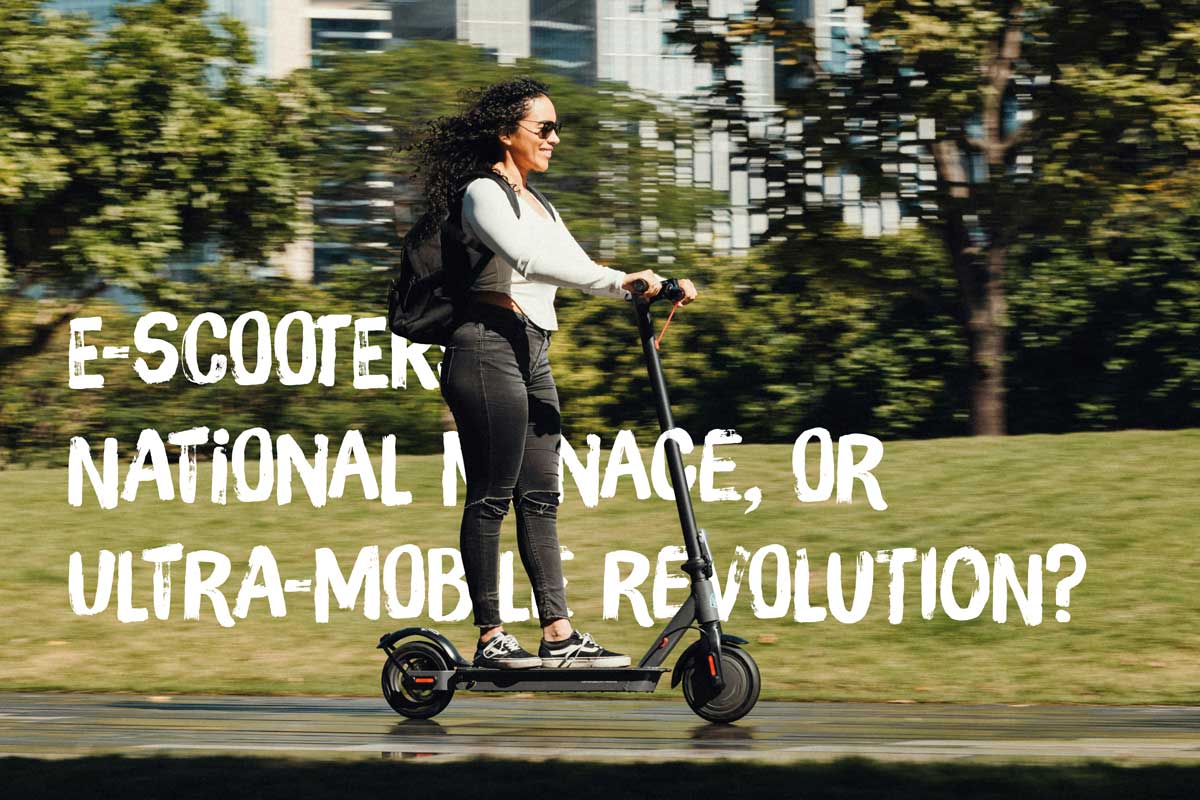
I’ll admit it — I sit somewhere in the middle on this one. The idea of cheap, fast travel that’s kinder to the planet than most petrol cars or motorbikes is genuinely appealing. A few years ago I very nearly bought one myself. Then I did some digging and found out that, in practice, e-scooters are illegal almost everywhere you’d actually want to ride them. That contradiction has never really left me, and with a fresh wave of e-scooter news breaking this month, it feels like the right time to unpack it — especially for anyone in Uxbridge thinking about buying one.
So why are they on sale at all?
Walk into Currys, Argos, or any big high-street retailer and you’ll find e-scooters sold openly, boxed up like any other bit of kit. What isn’t spelled out on the shelf is the loophole retailers are relying on: private e-scooters can only legally be ridden on private land, with the landowner’s permission.
In plain English, that means your garden — if you’re lucky that it’s big enough to be worth riding one in — or your house, if your hallways are cavernous enough to need one (and you’re even luckier). For everyone else, buying one puts you in a strange position: you own a product that’s fully legal to purchase and completely illegal to use for the journeys most people buy them for. Ride one to work, to the shops, or just around Uxbridge, and you’re breaking the law. Police can stop you, seize the scooter, and have it destroyed — no second chances.
It does seem a bit pointless to sell something so widely if you genuinely can’t use it. But that tension is exactly where things stand in 2026.
What the law actually says
Privately owned e-scooters are classed as motor vehicles under the Road Traffic Act 1988. That means, in theory, they need insurance, tax, registration, and construction standards no consumer e-scooter currently meets — so riding one on a public road, pavement, or cycle lane is treated the same as driving an uninsured car. The penalty is a £300 fixed penalty notice, six points, and potential seizure, with the case escalating to an unlimited fine or a driving ban if it goes to court.
During Covid — six years ago now — I remember MPs talking about looking into proper regulation, with a route to making private ownership legal because there are genuine upsides to them, otherwise nobody would be buying them. That review still hasn’t landed. As recently as this year, Transport Secretary Heidi Alexander told the BBC that “the genie’s out of the bottle” on e-scooters, acknowledging that huge numbers of people are already riding them illegally for daily commutes. The government has said new rules — mandatory lights, dual braking, hardware-limited top speeds, and a firm pavement ban — could come once parliamentary time allows, but no date has been fixed. A Private Member’s Bill, the E-scooters (Review and Awareness) Bill, was introduced in February 2026, but it only requires a formal review and better public awareness of the existing rules — not legalisation itself.
The insurance numbers are getting harder to ignore
New figures released just this week by the Motor Insurers’ Bureau put the picture in sharp focus. Since the first claim was paid out in 2019, compensation for injuries caused by e-scooters and e-bikes combined has passed £110 million — and the pace is accelerating fast, with around £47 million of that paid out in 2025 alone, up from roughly £30 million the year before. The worst single payout, for a child left with catastrophic injuries, was £20 million on its own.
Because these are technically uninsured motor vehicles, the bill for that compensation doesn’t fall on the rider — it’s spread across everyone’s motor insurance premiums via the MIB levy. The MIB is now openly calling for tighter regulation of how private e-scooters and e-bikes are sold, and in some cases outright bans, arguing there’s a widening gap between how normal it feels to ride one and how well people actually understand the law around them.
Zoom out further and uninsured driving as a whole — cars included — costs the UK economy around £1 billion a year once you factor in compensation, emergency services, healthcare, and lost productivity. £110 million is a fraction of that billion-pound total, but it’s the fastest-growing slice of it, and it’s growing because the government has left a legal grey area open for years rather than closing it one way or the other.
Why are Lime and Voi scooters legal, then?
This is the bit that confuses people the most, and fairly so. Rental scooters from operators like Lime and Voi are legal, but only within official trial areas run through Transport for London and the participating boroughs. Locally, Ealing is part of that trial and has been for a while — but Hillingdon isn’t, so you won’t find a legal rental scooter to hire in Uxbridge itself.
The difference between a Lime scooter and the one you’d buy at Currys isn’t really about the vehicle — it’s about control. Trial scooters are geofenced, automatically slowing or stopping in pedestrian-heavy “go-slow” and “no-go” zones, capped at around 12-12.5mph, professionally maintained, and covered by the operator’s own insurance rather than the rider’s. None of that is realistic to enforce on a scooter someone owns outright and can ride wherever they like. It’s also fair to say that operators with serious lobbying power have been able to get trial schemes off the ground in a way individual scooter owners simply can’t. Even if personal ownership were made optional-insurance-legal tomorrow, you’d have to ask who would actually take up cover voluntarily, and how many people would try to dodge it if they didn’t have to.
Where that leaves us
The honest version of this story is that the government has dragged its feet on something it’s never quite treated as urgent, while people have voted with their wallets regardless — buying scooters in growing numbers, some knowingly bending the rules, plenty of others genuinely unaware they’re breaking the law at all. I still meet people around Uxbridge who’ve bought one, or are about to, with no idea it’s illegal to ride on the road or pavement here.
None of this is unfixable. Countries like France and Germany already allow privately owned e-scooters on the road, provided they’re insured and meet set technical standards — proof that a working middle ground exists. The current national rental trials run until May 2028, gathering exactly the kind of safety data that could underpin permanent legislation, and the government has said it’s watching that data closely. Regulation clearly can bring the payout numbers down elsewhere — heavily regulated areas of motor insurance don’t see anything like the growth rate e-scooter claims are showing. So the tools are there. What’s been missing so far is the will to actually use them.
What do you think? Leave your comment below.
Sources: Motor Insurers’ Bureau, Auto Express, BBC, Weightmans, UK Parliament, Transport for London, London Borough of Ealing.

Author: MyUxbridge Admin
Admin and Webmaster of My Uxbridge
0 Comments